The RP2040 is Raspberry Pi’s debut microcontroller, combining high performance, low cost, and ease of …
The RP2040 is Raspberry Pi’s debut microcontroller, combining high performance, low cost, and ease of use in a compact package. With a large on-chip memory, symmetric dual-core processor, a deterministic bus fabric, and a versatile set of peripherals enhanced with the Programmable I/O (PIO) subsystem, it delivers unmatched power and flexibility for both professional and hobbyist users.
Its flexible I/O allows seamless interaction with almost any external device, while the high-performance cores handle integer workloads with ease. Designed for maximum efficiency, the six independent SRAM banks and fully connected bus fabric enable cores and DMA engines to run in parallel without contention.
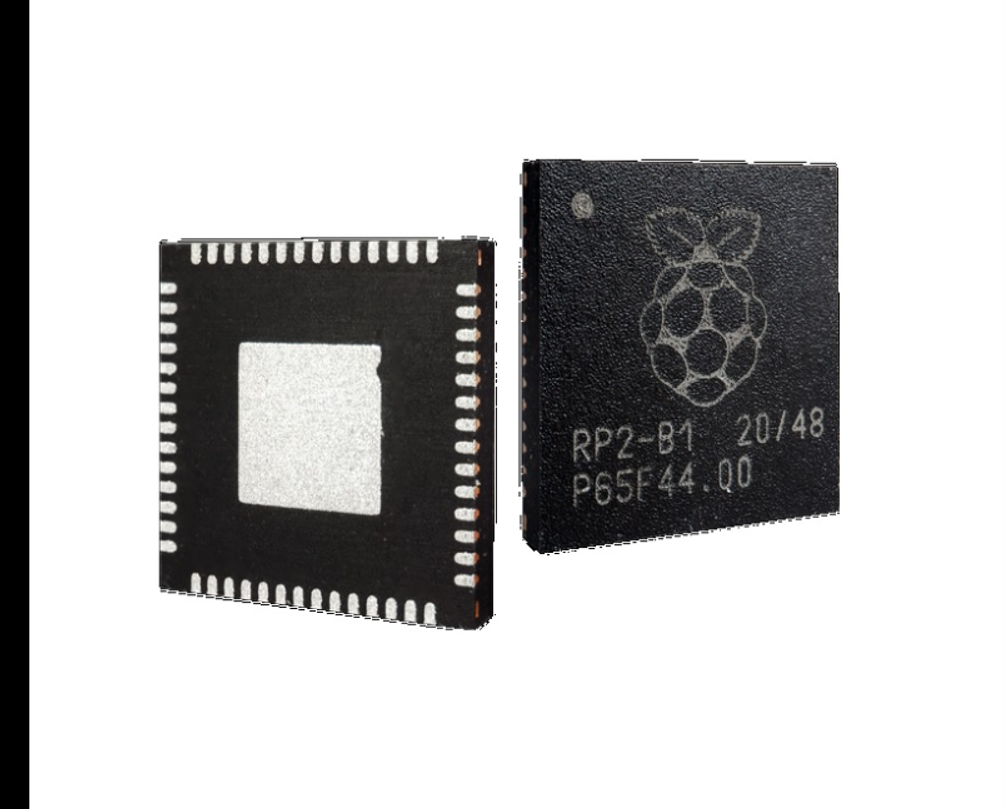
Housed in a 7 mm × 7 mm package with only 2 mm² of 40 nm silicon, RP2040 embodies Raspberry Pi’s commitment to cost-effective, high-performance computing. With comprehensive documentation, a polished MicroPython port, and a UF2 bootloader in ROM, it offers a minimal barrier to entry for beginners and hobbyists.
As a stateless device with support for cached execute-in-place from external QSPI Flash, RP2040 lets you select the appropriate density of non-volatile storage while benefiting from the affordability of commodity Flash. Manufactured on a modern 40 nm process node, it delivers high performance, low dynamic power consumption, and minimal leakage, with multiple low-power modes suitable for extended battery-powered operation.
Key Features and Specifications:
Processor: Dual ARM Cortex-M0+ @ 133 MHz
Memory: 264 KB on-chip SRAM in six independent banks
External Flash Support: Up to 16 MB via dedicated QSPI bus
DMA Controller for high-speed data transfers
Fully-connected AHB Crossbar for efficient core-peripheral communication
Interpolator and integer divider peripherals
On-chip programmable LDO for core voltage generation
2 on-chip PLLs for USB and core clocks
GPIO: 30 pins, 4 of which support analog inputs
Peripherals:
2 UARTs
2 SPI controllers
2 I²C controllers
16 PWM channels
USB 1.1 controller & PHY with host and device support
8 PIO state machines