The RP2040 is Raspberry Pi’s debut microcontroller, bringing the company’s hallmark values—high performance, low cost, …
The RP2040 is Raspberry Pi’s debut microcontroller, bringing the company’s hallmark values—high performance, low cost, and ease of use—to the microcontroller space. Featuring a symmetric dual-core processor, large on-chip memory, a deterministic bus fabric, and a versatile set of peripherals enhanced with the unique Programmable I/O (PIO) subsystem, RP2040 offers professional users exceptional power and flexibility.
Its flexible I/O allows connection to almost any external device, while its high-performance cores excel at integer workloads. The chip’s low cost helps lower the barrier to entry for both beginners and hobbyists.
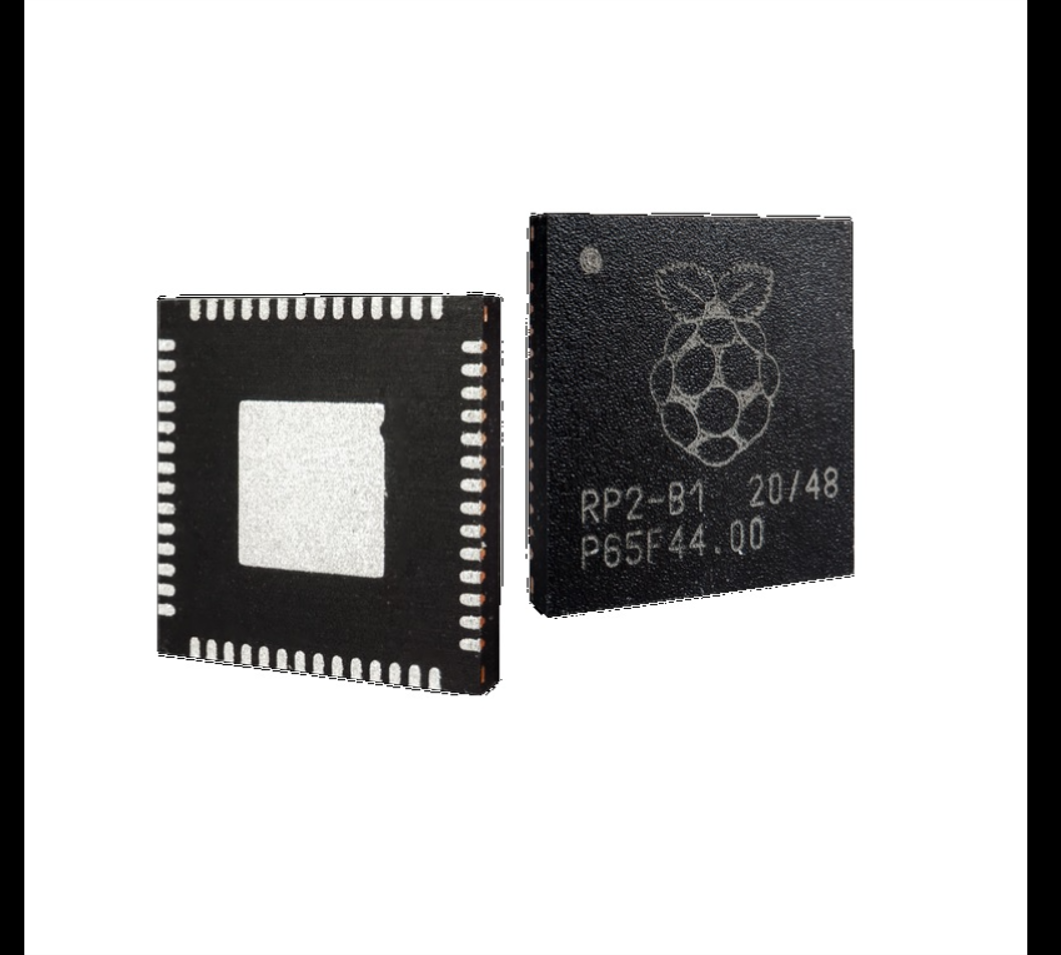
With six independent SRAM banks and a fully connected internal switch, RP2040 enables cores and DMA engines to operate in parallel without contention, ensuring maximum efficiency. Its compact 7 mm × 7 mm package contains just two square millimeters of 40nm silicon, combining Raspberry Pi’s philosophy of efficient, low-cost computing in a tiny footprint.
RP2040 also offers an approachable development experience, with detailed documentation, a polished MicroPython port, and a UF2 bootloader in ROM, making it ideal for beginners. As a stateless device, it supports cached execute-in-place from external QSPI Flash, allowing you to select the appropriate storage density for your application while benefiting from low-cost Flash options. Manufactured on a modern 40nm process, the RP2040 delivers high performance, low dynamic power, minimal leakage, and multiple low-power modes for battery-powered applications.
Read more about RP2040 on the Raspberry Pi Official Page [Click Here]
Key Features and Specifications:
Processor: Dual ARM Cortex-M0+ @ 133 MHz
Memory: 264 KB on-chip SRAM in six independent banks
External Flash Support: Up to 16 MB via dedicated QSPI bus
DMA Controller for high-speed data transfers
Fully-connected AHB crossbar for efficient core-peripheral communication
Interpolator and integer divider peripherals
On-chip programmable LDO for core voltage generation
2 on-chip PLLs for USB and core clock generation
GPIO: 30 pins, 4 of which support analog input
Peripherals:
2 UARTs
2 SPI controllers
2 I²C controllers
16 PWM channels
USB 1.1 controller and PHY (host & device support)
8 PIO state machines